Wednesday, 2 September 2026

What Is a Biometry Eye Test?

​A biometry eye test measures the dimensions of your eye to help an ophthalmologist plan cataract or lens surgery. The measurements may include the eye's length, corneal power, and other features used to calculate the power of an intraocular lens (IOL).

Because every eye is different, a biometry eye test is an essential part of personalized cataract planning. It is much more than a routine eyesight examination.

What Does a Biometry Eye Test Measure?

A biometry eye test measures the eye's axial length and provides important information about the cornea and front structures of the eye. These measurements are combined with your eye examination and medical history to estimate the IOL power that may provide the best possible visual outcome.

The American Academy of Ophthalmology states that ocular biometry is used to measure axial length before cataract surgery. The testing method depends on the clarity of the eye and the individual clinical situation.

Why Is a Biometry Eye Test Needed Before Cataract Surgery?
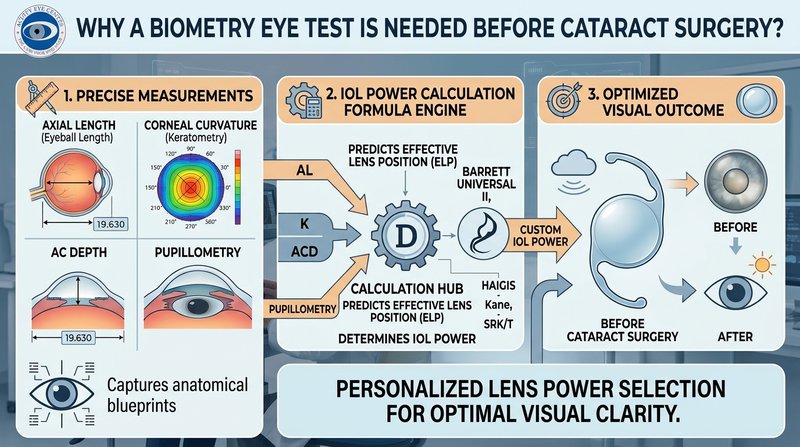
Before cataract surgery, a biometry is performed to help determine the correct artificial lens that will replace the cloudy natural lens.

The biometry allows the surgical team to make accurate calculations, although no test can guarantee a specific visual result. Other factors—including the health of the cornea, retina, optic nerve, previous eye surgery, and your visual expectations—also influence the final outcome.

Acuity Eye Center offers biometry eye testing and IOL calculation as part of its comprehensive ophthalmic services.

Is a Biometry Eye Test Painful?

A biometry eye test is usually painless. Most modern optical biometry devices are non-contact, meaning they measure your eye without touching its surface.

If a dense cataract or another condition prevents accurate optical measurements, your ophthalmologist may recommend an alternative method to complete the biometry eye test.

What Can Affect the Accuracy of a Biometry Eye Test?

The accuracy of a biometry eye test can be influenced by several factors, including:

  • Dense cataracts
  • Corneal irregularities
  • Difficulty maintaining steady fixation
  • Previous laser vision correction or refractive surgery
  • Other eye diseases

If necessary, your ophthalmologist may repeat the biometry eye test or use another measurement technique to improve accuracy.

The American Academy of Ophthalmology also notes that cataract planning considers corneal power, anterior chamber depth, retinal health, and optic nerve condition in addition to biometry measurements.

Questions to Ask Before Your Biometry Eye Test and IOL Calculation

To better understand your treatment plan, consider asking:

  • Which measurements were taken during my biometry eye test?
  • Were the measurements reliable and repeatable?
  • Which IOL options are suitable for my eyes?
  • Will I need additional tests such as corneal topography?
  • How much will I still depend on glasses after surgery?
  • Could another eye condition affect my final vision?

What Should You Bring to Your Biometry Eye Test Appointment?

To get the most from your biometry eye test, bring:

  • Your current glasses
  • Previous eye examination reports
  • A list of medications
  • Records of previous eye surgeries

Also inform your ophthalmologist if you have diabetes, glaucoma, retinal disease, or have previously undergone laser vision correction.

Final Takeaway

A biometry eye test is a key step in planning cataract or lens replacement surgery. It provides detailed eye measurements that help your ophthalmologist choose the most appropriate intraocular lens for your individual eye. While a biometry eye test greatly improves surgical planning, the final visual outcome also depends on your overall eye health and other clinical factors. Discuss your measurements and treatment options with your ophthalmologist to understand what results are realistically achievable.

Wednesday, 6 May 2026

Angio OCT: Enhancing patient understanding at Acuity Eye Center

Understanding eye health can feel overwhelming for many patients. At Acuity Eye Center, we strive to make things simpler and clearer. One of the advanced tools we utilize to achieve this is Angio Optical Coherence Tomography (Angio-OCT), which is powered by Nidek. This cutting-edge technology plays a crucial role in our comprehensive eye care services, fostering better understanding and confidence among our patients, including the use of Dragonfly opStar™.

What is Angio OCT?

Angio OCT represents a leap forward in the field of eye diagnostics. This non-invasive imaging test provides detailed images of the retina's blood vessels without the need for dye injections. It captures high-resolution cross-sectional images, allowing doctors to examine each of the retina's distinctive layers, including the macula. This technology is particularly useful in diagnosing and monitoring diseases like age-related macular degeneration and diabetic eye disease, enabling early detection and management of disease progression. The high sensitivity of this advanced technology helps in accurately diagnosing progressive eye diseases and monitoring retinal microvasculature.

How Angio OCT benefits our patients

  1. Non-invasive experience
    Patients appreciate the comfort offered compared to older methods. The procedure is quick and doesn't require any injections or contact with the eye, minimizing discomfort and stress. This contributes significantly to patient safety and comfort.
  2. Precise diagnostics
    Our team can detect subtle changes, such as microaneurysms, in the retina much earlier than traditional methods. This accuracy enables early disease detection and proactive management, providing more treatment options and improved patient outcomes.
  3. Clear communication
    The clarity of Angio OCT images allows us to explain conditions and treatment plans with greater transparency. We can show patients exactly what we see, which enhances their understanding and contributes to a trustworthy relationship.

Application of Angio OCT in various eye conditions

Managing diabetic eye disease

Patients with diabetes are often concerned about their eye health. Angio OCT enables us to spot early signs of diabetic retinopathy and abnormal telangiectatic vessels before symptoms develop, allowing timely intervention. Our approach integrates advanced technology with patient education to effectively manage this condition.

Monitoring macular degeneration

For those diagnosed with age-related macular degeneration, Angio OCT is invaluable. It helps in regularly monitoring the condition's progression, ensuring our treatment approaches are tailored to each patient’s changing needs. This allows for more appropriate treatment based on individual OCTA findings, particularly focusing on the outer retina and retinal nerve fiber layer.

Our commitment to patient-centered care

At Acuity Eye Center, we are committed to utilizing the latest technologies to enhance patient care. The trust placed in our esteemed professionals, such as Dr. Zia ul Mazhry, underscores our dedication to excellence. Beyond technology, our focus is on delivering compassionate, tailored care to all patients.

Why choose Acuity Eye Center?

Our center is more than just a place for eye testing. We offer a holistic approach to eye health, featuring services from advanced glaucoma surgery to laser vision correction. By integrating Angio OCT and other state-of-the-art technologies, we ensure a comprehensive, reassuring patient experience.

For more information on how we can help you with your eye health, visit our website. At Acuity Eye Center, enhancing your vision and understanding is at the heart of everything we do.