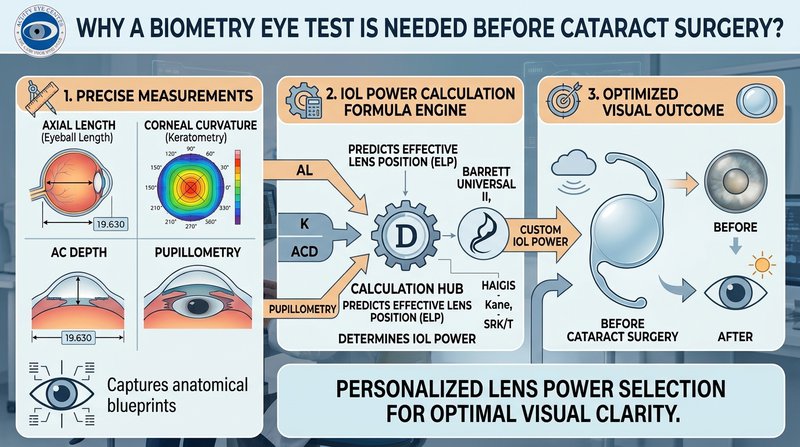
A biometry eye test measures the dimensions of your eye to help an ophthalmologist plan cataract or lens surgery. The measurements may include the eye's length, corneal power, and other features used to calculate the power of an intraocular lens (IOL).
Because every eye is different, a biometry eye test is an essential part of personalized cataract planning. It is much more than a routine eyesight examination.
What Does a Biometry Eye Test Measure?
A biometry eye test measures the eye's axial length and provides important information about the cornea and front structures of the eye. These measurements are combined with your eye examination and medical history to estimate the IOL power that may provide the best possible visual outcome.
The biometry allows the surgical team to make accurate calculations, although no test can guarantee a specific visual result. Other factors—including the health of the cornea, retina, optic nerve, previous eye surgery, and your visual expectations—also influence the final outcome.
Acuity Eye Center offers biometry eye testing and IOL calculation as part of its comprehensive ophthalmic services.
Is a Biometry Eye Test Painful?
A biometry eye test is usually painless. Most modern optical biometry devices are non-contact, meaning they measure your eye without touching its surface.
If a dense cataract or another condition prevents accurate optical measurements, your ophthalmologist may recommend an alternative method to complete the biometry eye test.
What Can Affect the Accuracy of a Biometry Eye Test?
The accuracy of a biometry eye test can be influenced by several factors, including:
Dense cataracts
Corneal irregularities
Difficulty maintaining steady fixation
Previous laser vision correction or refractive surgery
Other eye diseases
If necessary, your ophthalmologist may repeat the biometry eye test or use another measurement technique to improve accuracy.
The American Academy of Ophthalmology also notes that cataract planning considers corneal power, anterior chamber depth, retinal health, and optic nerve condition in addition to biometry measurements.
Questions to Ask Before Your Biometry Eye Test and IOL Calculation
To better understand your treatment plan, consider asking:
Which measurements were taken during my biometry eye test?
Were the measurements reliable and repeatable?
Which IOL options are suitable for my eyes?
Will I need additional tests such as corneal topography?
How much will I still depend on glasses after surgery?
Could another eye condition affect my final vision?
What Should You Bring to Your Biometry Eye Test Appointment?
To get the most from your biometry eye test, bring:
Your current glasses
Previous eye examination reports
A list of medications
Records of previous eye surgeries
Also inform your ophthalmologist if you have diabetes, glaucoma, retinal disease, or have previously undergone laser vision correction.
Final Takeaway
A biometry eye test is a key step in planning cataract or lens replacement surgery. It provides detailed eye measurements that help your ophthalmologist choose the most appropriate intraocular lens for your individual eye. While a biometry eye test greatly improves surgical planning, the final visual outcome also depends on your overall eye health and other clinical factors. Discuss your measurements and treatment options with your ophthalmologist to understand what results are realistically achievable.
Acuity Eye Center Lahore Pakistan and the American Academy of Ophthalmology reveal seven common misunderstandings about children's eye health.
ایکوئٹی آئی سنٹر لاہور پاکستان اور امریکن اکیڈمی آف اوفتھلمولوجی بچوں کی آنکھوں کی صحت کے بارے میں سات عام غلط نظریات کے بارے میں آگہی فراہم کر رہی ہے۔
Think you have the facts on your child’s eye care? When is the right time to have their eyes checked? Is too much screen time damaging their eyes? Do they need to wear sunglasses? There are a lot of myths and misinformation out there about children’s eye health. Don’t turn to Dr. Google for answers, ask your ophthalmologist — a physician who specializes in medical and surgical eye care — if you want to set your child up for a lifetime of good vision.
ان کی آنکھوں کی جانچ پڑتال کرنے کا صحیح وقت کب ہے؟ کیا بہت زیادہ اسکرین ٹائم ان کی آنکھوں کو نقصان پہنچا رہا ہے؟ کیا انہیں دھوپ میں پہننے والے چشمے کی ضرورت ہے؟ بچوں کی آنکھوں کی صحت کے بارے میں بہت ساری غلط معلومات ہیں۔امراض چشم کے ماہر ڈاکٹر سے اس بارے پوچھیں ۔اگر آپ اپنے بچوں کو زندگی بھر اچھی نظر کے ساتھ دیکھنا چاہتے ہیں۔
Here, Acuity Eye Center Lahore Pakistan and the American Academy of Ophthalmology debunk seven common myths about children’s eye health:
Pink eye only happens in young children
While young kids are known for getting pink eye, due to close contact in daycare centers, so can teenagers, college students, and adults — especially those who don’t clean their contacts properly. The best way to keep the pink eye from spreading is to practice good hygiene, including washing your hands, not touching your eyes, and using clean towels and other products around the face.
Antibiotics are necessary to cure your child’s pink eye
Antibiotics are rarely necessary to treat pink eye. There are three types of pink eye: viral, bacterial, and allergic conjunctivitis. Most cases are caused by viral infections or allergies and do not respond to antibiotics. Antibiotics may be prescribed for bacterial conjunctivitis depending on severity. Mild cases of bacterial conjunctivitis usually resolve on their own within 7 to 14 days without treatment.
گلابی آنکھ کا علاج کرنے کے لئے اینٹی بائیوٹکس شاذ و نادر ہی ضروری ہیں۔ گلابی آنکھ کی تین اقسام ہیں: وائرل ، بیکٹیریل اور الرجک آشوب چشم۔ زیادہ تر گلابی آنکھیں وائرل انفیکشن یا الرجی کی وجہ سے ہوتی ہیں اور اینٹی بائیوٹکس سے ٹھیک نہیں ہوتی ہیں۔ اینٹی بائیوٹکس بیکٹیریل آشوب چشم کیلئے تجویز کیا جاسکتی ہیں۔ بیکٹیریل آشوب چشم عام طور پر بغیر علاج کے 7 سے 14 دن کے اندر خود ہی ٹھیک ہوجاتے ہیں۔
Sun is bad for your eyes
While it’s true that long-term exposure to the sun without proper protection can increase the risk of eye disease, some studies suggest sun exposure is necessary for normal visual development. Children who have less sun exposure seem to be at higher risk for developing myopia or nearsightedness. Just make sure they’re protected with UV-blocking sunglasses and sunscreen.
Blue light from screens is damaging children’s vision
Contrary to what you may be reading on the Internet, blue light is not blinding you or your screen-obsessed kids. While it is true that nearsightedness is becoming more common, blue light isn’t the culprit. In fact, we are exposed to much more blue light naturally from the sun than we are from our screens.
The important thing to remember is to take frequent breaks. The Academy recommends a 20-20-20 rule: look at an object at least 20 feet away every 20 minutes for at least 20 seconds.
Vision loss only happens to adults
The eyes of a child with amblyopia (lazy eye) may look normal, but this eye condition can steal sight if not treated. Amblyopia is when vision in one of the child’s eyes is reduced because the eye and brain are not working together properly. Strabismus (crossed eyes) is another eye condition that can cause vision loss in a child. Strabismus is when the eyes do not line up in the same direction when focusing on an object.
ایمبلائےاوپیا (سست آنکھ) والے بچے کی آنکھیں معمول کی طرح نظر آسکتی ہیں ، لیکن علاج نہ ہونے کی صورت میں آنکھ کی یہ حالت نظر کو چوری کر سکتی ہے۔ ایمبلائےاوپیا (سست آنکھ) اس وقت ہوتا ہے جب بچے کی آنکھوں میں سے کسی کی بینائی کم ہوجاتی ہے کیونکہ آنکھ اور دماغ ایک ساتھ کام نہیں کررہےہوتے ہیں۔ سٹرابیسمس آنکھوں کی ایک اور حالت ہے جو کسی بچے میں بینائی کی کمی کا سبب بن سکتی ہے۔ جب کسی شے پر توجہ مرکوز کرتے وقت آنکھیں ایک ہی سمت میں نہیں کھڑی ہوتی ہیں تو اسٹرابیزمس ہوتا ہے
All farsighted children need glasses
Most children are farsighted early in life. It’s actually normal. It doesn’t necessarily mean your child needs glasses because they use their focusing muscles to provide clear vision for both distance and near vision. Children do need glasses when their farsightedness blurs their vision or leads to strabismus. They will also need glasses if they are significantly more farsighted in one eye compared with the other, a condition that puts them at risk of developing amblyopia.
There is no difference between a vision screening and a vision exam
While it’s true that your child’s eyes should be checked regularly, a less invasive vision screening by a pediatrician, family doctor, ophthalmologist, optometrist, orthoptist, or person trained in vision assessment of preschool children, is adequate for most children. If the screening detects a problem, the child may need to see an ophthalmologist or other eye care professional. A comprehensive exam involves the use of eye drops to dilate the pupil, enabling a more thorough investigation of the overall health of the eye and visual system.
اگرچہ یہ سچ ہے کہ آپ کے بچے کی آنکھوں کی باقاعدگی سے جانچ ہونی چاہئے ، بچوں کے ماہر امور ، فیملی ڈاکٹر ، ماہر نفسیات ، آپٹومیٹرسٹ ، آرتھوپٹسٹ یا پری اسکول کے بچوں کی نظر کی تشخیص میں تربیت یافتہ شخص کے ذریعہ نظر چیک کرنا کافی ہے۔ اگر اسکریننگ سے کسی مسئلے کا پتہ چل جاتا ہے تو ، بچے کو کسی ماہر نفسیات یا آنکھوں کی دیکھ بھال کرنے والے پیشہ ور افراد سے ملنے کی ضرورت پڑسکتی ہے۔ آنکھوں کے معائنے کے دوران طالب علم کی آنکھوں کی پیوپل کو پھیلانے کے لئے آنکھوں کے قطروں کا استعمال شامل ہے ، جس سے آنکھ اور بصری نظام کا اچھی طرح معائنہ ہوتا ہے۔
“As the kids head back to school, show them that you’ve done your homework,” said Dianna Seldomridge, MD, clinical spokesperson for the American Academy of Ophthalmology. “Educate yourself so they will have the best chance to preserve their vision for a lifetime.”
"Your child’s vision is critical and even more critical is protecting it during everyday activities. Eye injuries occur most commonly during outdoor sports or athletics. The parents and guardian need to pay close attention as a caregiver. If the kids are left alone, will often opt to not wear protective eyewear when playing sports, let alone a helmet, due to a number of reasons. Therefore, it’s up to you to ensure your child’s eyes and vision are kept safe."
آپ کے بچے کی نظر اہم ہے اور اس سے بھی زیادہ اہمیت اس کی روزمرہ کی سرگرمیوں کے دوران حفاظت کرنا ہے۔ آنکھوں کی چوٹیں بیرونی کھیلوں یا ایتھلیٹکس کے دوران عام طور پر لگ جاتی ہیں۔ والدین اور سرپرست کو دیکھ بھال کرنے والے کی حیثیت سے بہت زیادہ توجہ دینے کی ضرورت ہوتی ہے۔ اگر بچوں کو تنہا چھوڑ دیا جاتا ہے تو ، وہ اکثر کھیلوں کے دوران حفاظتی چشمہ پہننے کا انتخاب نہیں کرتے ہیں ،اور متعدد وجوہات کی بنا پر ہیلمٹ چھوڑ دیتے ہیں۔ لہذا ، یہ آپ پر منحصر ہے کہ آپ اپنے بچے کی آنکھوں اور نظر کی حفاظت کو یقینی بنائیں۔
About the American Academy of Ophthalmology
The American Academy of Ophthalmology is the world’s largest association of eye physicians and surgeons. A global community of 32,000 medical doctors, we protect sight and empower lives by setting the standards for ophthalmic education and advocating for our patients and the public. We innovate to advance our profession and to ensure the delivery of the highest-quality eye care. Our EyeSmart® program provides the public with the most trusted information about eye health. For more information, visit aao.org.
Contact Our Team:
If you are looking for any of the below services, please fill the form below, one of our team members will get in to provide you with full facilitation:
Acuity Eye Centre Lahore Pakistan and the American Academy of Ophthalmology say blindness is often preventable with regular healthcare
By age 65, one in three Americans will have a vision-impairing eye disease. Many sight-robbing conditions can be effectively treated if detected early enough, in many cases limiting or eliminating the damage to eyesight. During the month of May, Acuity Eye Centre Lahore Pakistan joins the American Academy of Ophthalmology is sharing valuable information about how to take care of your vision.
Four eye diseases — age-related macular degeneration (AMD), diabetic retinopathy, glaucoma, and cataracts — account for most cases of adult blindness and low vision among people in developed countries. Because these eye diseases cause no pain and often have no early symptoms, they do not automatically prompt people to seek medical care. But a thorough checkup by an ophthalmologist — a physician who specializes in medical and surgical eye care — can detect them in their earliest stages. Early treatment is vital because it can slow or halt disease progression or, in the case of cataracts, restore normal vision.
A thorough eye exam can also detect other health conditions, such as stroke, cardiovascular disease, diabetes, high blood pressure, autoimmune diseases, sexually transmitted diseases, and some cancers. It’s not uncommon for a trip to the ophthalmologist to actually save a life.
The Academy’s global community of 33,000 physicians urges you to follow these five simple steps to take control of your eye health today: Get a comprehensive medical eye exam at age 40. Early signs of disease or changes in vision may begin at this age. An exam by an ophthalmologist is an opportunity to carefully examine the eye for diseases and conditions that may have no symptoms in the early stages. For those concerned about the cost of an exam, the Academy’s EyeCare America® program may be able to help. More than 5,500 dedicated volunteer ophthalmologists provide eye exams and care, often at no out-of-pocket cost to eligible patients.
5 Steps to Lower Your Risk of Eye Disease
Know your family history
Certain eye diseases can be inherited. If you have a close relative with macular degeneration, you have a 50 percent chance of developing this condition. A family history of glaucoma increases your glaucoma risk by four to nine times. Talk to family members about their eye conditions. It can help you and your ophthalmologist evaluate your risk.
Eat healthy foods
A diet low in fat and rich in fruits, vegetables, and whole grains, benefits the entire body, including the eyes. Eye-healthy food choices include citrus fruits, vegetable oils, nuts, whole grains, dark green leafy vegetables, and cold-water fish.
Stop smoking
Stop Smoking
Smoking increases the risk of eye diseases such as cataract and age-related macular degeneration. Smoking also raises the risk for cardiovascular diseases which can indirectly influence your eye health. Tobacco smoke, including second-hand smoke, also worsens dry eye.
Wear sunglasses
SunGlasses
Exposure to ultraviolet UV light raises the risk of eye diseases, including cataract, fleshy growths on the eye, and cancer. Always wear a hat and sunglasses with 100 percent UV protection while outdoors.
“An eye exam doesn’t just check how well you can see, it evaluates the overall health of your eyes,” said Rebecca J. Taylor, M.D., clinical spokesperson for the American Academy of Ophthalmology. “The Academy encourages everyone, particularly if you’re over age 40, to get regular eye care. By making the vision a priority, we can help protect our sight as we age.”
Here is the message of our lead consultant Professor Zia Ul Mazhry
There is a saying"Eyes are the windows to the soul".Healthy Vision is one of the best blessings of Almighty Allah at any given age. So protect your vision by quitting smoking, eating healthy foods, and having a regular comprehensive eye examination.
ایک کہاوت ہے "آنکھیں روح کی کھڑکیاں ہیں" ۔ درست بینائی کسی بھی عمر میں اللہ تعالٰی کی دی ہوئی بہترین نعمت ہے۔ لہذا تمباکو نوشی چھوڑ کر ، صحت مند غذائیں کھا کر اور آنکھوں کا باقاعدگی سے معائنہ کر وا کر اپنی نظر کی حفاظت کریں۔
About the American Academy of Ophthalmology
The American Academy of Ophthalmology is the world’s largest association of eye physicians and surgeons. A global community of 32,000 medical doctors, we protect sight and empower lives by setting the standards for ophthalmic education and advocating for our patients and the public. We innovate to advance our profession and to ensure the delivery of the highest-quality eye care. Our EyeSmart® program provides the public with the most trusted information about eye health. For more information, visit aao.org.
About Eye Health education by Acuity Eye Center Lahore
Welcome to the Education Portal of Acuity Eye Centre Lahore Pakistan. We are committed to serving our patients and our community, to the development and propagation of new concepts to preserve and enhance vision. Our three missions—clinical service, education, and research—are closely interrelated. https://eyeacuity.com/education
Contact Our Team:
If you are looking for any of below services, please fill the form below, one of our team members will get in to provide you with full facilitation:
The impact of COVID-19 (Coronavirus) continues to evolve and we at Acuity Eye Centre are closely following guidance from the Department of Health, Royal College of Ophthalmologists and the American Academy of Ophthalmology.
Discontinuation of Elective Services at Acuity Eye Centre
In light of the rapid increase in the number of cases in Pakistan and the strong desire by the government to control the crisis by lockdown strategy, we have discontinued all elective operations and outpatient clinics from Monday 23rd March 2020 across all our facilities. We apologise to all who are inconvenienced and please understand that this is in the national interests. The situation is being reviewed daily by the AEC executive team and we shall make changes based on available advice and recommendations.
We shall continue to take phone calls, emails and communication through our regular channels.
Like yourselves, we are hopeful that with all measures being taken collectively the pandemic will come under better control and permit us to function more normally.
Availability of free online Audio Video Consultation for YOUR Eye Care Needs
We shall, however, be available for online audio and video consultation related to eye care.
کوویڈ ۱۹کے اثرات اب بھی ارتقاء پزیر ہیں اور ہم ایکیوٹی آئی سنٹر میں محکمہ صحت ، رائل کالج آف اوفتھلمولوجسٹ اور امریکن اکیڈمی آف چشمِ امراض کی رہنمائی کا قریب سے مشاہدہ کررہے ہیں۔
ایکیوٹی آئی سنٹر میں عمومی خدمات کا سلسلہ بند کرنا
پاکستان میں کیسوں کی تعداد میں تیزی سے اضافہ اور حکومت کی جانب سے لاک ڈاؤن حکمت عملی کے ذریعے بحران پر قابو پانے کی شدید خواہش کی روشنی میں ، ہم نے اپنی تمام سہولیات میں پیر 23 مارچ 2020 سے تمام انتخابی آپریشنز اور آؤٹ پیشنٹ کلینک بند کردیئے ہیں۔ تکلیف کے لئیے معذرت خواہ ہیں اور براہ کرم سمجھیں کہ یہ قومی مفادات میں ہے۔ اے ای سی کی ایگزیکٹو ٹیم کے ذریعہ صورتحال کا روزانہ جائزہ لیا جاتا ہے اور ہم دستیاب مشوروں اور سفارشات کی بنیاد پر تبدیلیاں کریں گے۔
ہم اپنے باقاعدہ چینلز کے ذریعے فون کالز ، ای میلز کے ذریعے اپنے مریضوں سے رابطہ کرتے رہیں گے۔
آپ کی طرح ، ہم بھی پر امید ہیں کہ اجتماعی طور پر اٹھائے جانے والے تمام اقدامات کے ساتھ وبائی مرض بہتر کنٹرول میں آجائے گا اور ہمیں حسبِ معمول کام کرنے کی اجازت دے گا۔
آپ کی آنکھوں کی دیکھ بھال کی ضروریات کے لئیے مفت آن لائن آڈیو ویڈیو مشاورت کی دستیابی
تاہم ہم آنکھوں کی دیکھ بھال سے متعلق آن لائن آڈیو اور ویڈیو مشاورت کے لئیے دستیاب ہوں گے۔
Sixty percent of Americans with Diabetes Skip Annual Sight-Saving Exams
Acuity Eye Center Lahore PakistanandtheAmerican Academy of Ophthalmology reiterate the importance of dilated eye exams in preventing vision loss. People with diabetes are at increased risk of developing serious eye diseases, yet most do not have sight-saving, annual eye exams, according to a large study. The Acuity Eye Center Lahore Pakistan joins the Academy in reiterating the importance of eye exams during the month of November, which is observed as Diabetic Eye Disease Awareness Month.
Researchers at Wills Eye Hospital in Philadelphia have found that more than half of patients with the disease skip these exams. They also discovered that patients who smoke – and those with less severe diabetes and no eye problems – were most likely to neglect to have these checks.
One in 10 Americans has diabetes, putting them at heightened risk for visual impairment due to the eye disease diabetic retinopathy. The disease also can lead to other blinding ocular complications if not treated in time. Fortunately, having a dilated eye exam yearly or more often can prevent 95 percent of diabetes-related vision loss. Diabetes is the leading cause of new cases of blindness in adults, with patients with diabetes 25 times more likely to become blind than those who do not have diabetes.
Diabetic Retinopathy
Diabetic Retina
It is also known as diabetic eye disease, which is a medical condition in which damage occurs to the retina due to diabetes mellitus. It is a leading cause of blindness. Diabetic retinopathy affects up to 80 percent of those who have had diabetes for 20 years or more.
Symptoms Of Diabetic Retinopathy
Symptoms Of Diabetic Retinopathy
You first may notice diabetic retinopathy (DR) or other eye problems related to diabetes when you have symptoms such as:
Fluctuating vision
Eye floaters and spots
Development of a scotoma or shadow in your field of view
Blurry and/or distorted vision
Corneal abnormalities such as slow healing of wounds due to corneal abrasions
Double vision
Eye pain
Near vision problems unrelated to presbyopia
Prevention
Prevention of Diabetic Retinopathy
Work with your doctor to keep your blood sugar and blood pressure at good levels. This will help to slow down diabetic retinopathy, and may even prevent it.
Make sure you see an eye doctor at least once a year for a complete eye exam. If you have diabetes and are pregnant, you should also have a thorough eye exam during the first trimester, and follow up with an eye doctor during pregnancy.
Eye exams are critical as they can reveal hidden signs of disease, enabling timely treatment. This is why the Academy recommends people with diabetes have them annually or more often as recommended by their ophthalmologist, a physician who specializes in medical and surgical eye care.
Dilated Eye Exam For Diabetic Retinopathy
Dilated eye exam
Diabetic retinopathy is best diagnosed with a comprehensive dilated eye exam. For this exam, drops placed in your eyes widen (dilate) your pupils to allow your doctor to better view inside your eyes. The drops may cause your close vision to blur until they wear off, several hours later
“Vision loss is tragic, especially when it is preventable,” said Ann P. Murchison, M.D., M.P.H., lead author of the study and director of the eye emergency department at Wills Eye Hospital. “That’s why we want to raise awareness and ensure people with diabetes understand the importance of regular eye exams.”
The Academy offers this animated public service announcement to help educate people about the importance of regular exams and common eye diseases including diabetic retinopathy. It encourages the public to watch and share it with their friends and family.
Here is the message of our Lead consultant Professor Dr. Zia Ul Mazhry
"Diabetic retinopathy is a scientific term that means damage to the retina caused by leaky vessels of new vessel formation on the retina. Early detection is the key to damage control and devising a treatment plan. Moreover, by managing diabetes, you can reduce the progression of this disease affecting your eyesight. Patients having a high risk of diabetic retinopathy should know that regular examination and followup by a qualified eye specialist is the only way to timely diagnoses of this blinding disease. The sooner the diagnosis is established, the better custom treatment plan can be materialized."
American seniors 65 and older may be eligible to get a medical eye exam at no cost through EyeCare America, a public service program of the Academy. For more information about diabetic eye disease, visit the Acuity Eye center's Website website.
About the American Academy of Ophthalmology
The American Academy of Ophthalmology is the world’s largest association of eye physicians and surgeons. A global community of 32,000 medical doctors, we protect sight and empower lives by setting the standards for ophthalmic education and advocating for our patients and the public. We innovate to advance our profession and to ensure the delivery of the highest-quality eye care. Our EyeSmart® program provides the public with the most trusted information about eye health. For more information, visit aao.org. and eyeacuity.com
About Eye Health Education By Acuity Eye Center Lahore Pakistan:
Welcome to the Education Portal of Acuity Eye Centre Lahore Pakistan. We are committed to serving our patients and our community, to the development and propagation of new concepts to preserve and enhance vision. Our three missions—clinical service, education, and research—are closely interrelated. Visit:https://eyeacuity.com/education/
Contact Our Team:
If you are looking for any of below services, please fill the form below, one of our team members will get in to provide you with full facilitation:
Ophthalmologists Encourage Making Your Eyes Part of a Healthy Aging Strategy
Nearly two-thirds of American adults report eye or vision problems, but only one in eight have been examined by a medical doctor.
According to a national survey released by the American Academy of Ophthalmology, nearly two out of three American adults report having eye or vision problems. A significant percentage of them, however, fail to seek medical attention in the form of regular, sight-saving eye exams. In observance of Healthy Aging Month in September, the Acuity Eye Center Lahore Pakistan joins the American Academy of Ophthalmology in emphasizing the importance of having regular eye exams to maintain healthy eyes and vision.
Some of the more common age-related eye diseases include:
Age-related Macular degeneration.
which gradually destroys the macula, the part of the eye that provides sharp, central vision.
Age Related Macular Degeneration
Cataract
a clouding of the lens in the eye.
Cataract
Diabetic Retinopathy
a complication of diabetes that damages blood vessels in the retina, the light-sensitive tissue at the back of the eye.
Diabetic Retinopathy
Glaucoma
a group of diseases that can cause fluid and pressure to build up in the eye and damage the optic nerve.
Glaucoma Field Loss
Ophthalmologists – the physicians that specialize in medical and surgical eye care – recommend a dilated comprehensive eye exam as the best way to prevent these conditions from becoming debilitating.
U.S. Adults Do Not Get Eye Exams as Often as Recommended
The survey results emphasize a need for more education about the importance of medical eye exams. Findings showed that 64 percent of adults had at least one or more of the following issues with their eyes or vision:
Difficulty seeing at night
Blurry vision
Reading up close
Flashes of light
Red, Watery Eyes
Double vision
Despite experiencing some level of impairment, only 13 percent admitted they had been seen by an ophthalmologist.
" Aging is not lost youth but a new stage of opportunity and strength. You can't avoid age. However, we can avoid some aging. Continue to do things, be active. Take care of your health, especially the vision because this will keep you connected to the rest of the world during aging process."
How Often Do Adults Need Eye Exams?
Adult Eye Examination
The Academy recommends that a healthy adult get a baseline eye exam at age 40, even if they have no history of eye problems or eye disease. Those who have chronic conditions, such as diabetes or high blood pressure, may require more frequent exams.
Those over age 65 who may be concerned about cost or lack of health insurance, the American Academy of Ophthalmology’s EyeCare America program offers eligible seniors a comprehensive eye exam and up to one year of treatment at no out-of-pocket cost.
For more information on eye disease and conditions, visit the Academy’s EyeSmart® website and Acuity Eye Center's website eyeacuity.com. To interview ophthalmologists or patients who can speak to the importance of eye exams.
About Eye Health Education By Acuity Eye Center Lahore Pakistan:
Welcome to the Education Portal of Acuity Eye Centre Lahore Pakistan. We are committed to serving our patients and our community, to the development and propagation of new concepts to preserve and enhance vision. Our three missions—clinical service, education and research—are closely interrelated.Visit: https://eyeacuity.com/education/
Contact Our Team:
If you are looking for any of below services, please fill the form below, one of our team member will get in to provide you with full facilitation:
Women make up 65 percent of AMD cases, 61 percent of glaucoma and cataract cases, and 66 percent of blind patients.
Whatever the cause, there are a few unique vision problems women need to watch out for more than men. Dry eye occurs at double the rate in postmenopausal women. In general, women are more susceptible to autoimmune diseases than men, many of which affect vision, such as lupus, Sjögren’s syndrome and hyperthyroiditis. Also, pregnancy can cause vision changes due to hormone fluctuations.
Good news is most vision loss is preventable. The Academy offers five simple steps to take control of your eye health today:
Get a comprehensive medical eye exam at age 40
Early signs of disease or changes in vision may begin at this age. An exam by an ophthalmologist – a physician who specializes in medical and surgical eye care – is an opportunity to carefully examine the eye for diseases and conditions that may have no symptoms in the early stages. For those concerned about the cost of an exam, the Academy’s EyeCare America® program may be able to help. More than 5,500 dedicated volunteer ophthalmologists provide eye exams and care, often at no out-of-pocket cost to eligible patients. Learn if you qualify at eyecareamerica.org and www.eyeacuity.com
Know your family history
Certain eye diseases can be inherited. If you have a close relative with macular degeneration, you have a 50 percent chance of developing this condition. A family history of glaucoma increases your glaucoma risk by four to nine times. Talk to family members about their eye conditions. It can help you and your ophthalmologist evaluate your risk.
Eat Eye Healthy Foods
A diet low in fat and rich in fruits, vegetables, and whole grains, benefits the entire body, including the eyes. Eye-healthy food choices include citrus fruits, vegetable oils, nuts, whole grains, dark green leafy vegetables and cold water fish.
Stop Smoking
Smoking increases the risk for eye diseases such as cataract and age-related macular degeneration. Smoking also raises the risk for cardiovascular diseases which can indirectly influence your eye health. Tobacco smoke, including second-hand smoke, also worsens dry eye.
Wear Sunglasses
Exposure to ultraviolet UV light raises the risk of eye diseases, including cataract, fleshy growths on the eye and cancer. Always wear a hat and sunglasses with 100 percent UV protection while outdoors.
Professor Mazhry's Talk on Summer effects on the eyes
“Eye exams aren’t only about checking a person's visual acuity or sharpness, but also determining the overall health of their eyes,” said Rebecca J. Taylor, M.D., clinical spokesperson for the American Academy of Ophthalmology. “We encourage everyone, particularly if you’re over age 40, to get regular eye care. By making vision a priority, we can help protect our sight as we age.”
There is a saying"Eyes are the windows to the soul".Healthy Vision is one of the best blessing of Almighty Allah at any given age.So protect your vision by quitting smoking, eating healthy foods and having regular comprehensive eye examination .
To learn more ways to keep your eyes healthy, visit the American Academy of Ophthalmology’s EyeSmart® website and Acuity Eye Center Lahore's Website
About the American Academy of Ophthalmology
The American Academy of Ophthalmology is the world’s largest association of eye physicians and surgeons. A global community of 32,000 medical doctors, we protect sight and empower lives by setting the standards for ophthalmic education and advocating for our patients and the public. We innovate to advance our profession and to ensure the delivery of the highest-quality eye care. Our EyeSmart® program provides the public with the most trusted information about eye health. For more information, visit aao.org.
About EyeCare America
EyeCare America, one of the country’s leading public service programs provides eye care through a pool of nearly 6,000 volunteer ophthalmologists. Since 1985, EyeCare America has helped more than 1.8 million people. Ninety percent of the care provided is at no out-of-pocket cost to the patient. For more information, visit eyecareamerica.org and eyeacuity.com
About Eye Health education by Acuity Eye Center Lahore
Welcome to the Education Portal of Acuity Eye Centre Lahore Pakistan. We are committed to serving our patients and our community, to the development and propagation of new concepts to preserve and enhance vision. Our three missions—clinical service, education and research—are closely interrelated. https://eyeacuity.com/education
Contact Our Team:
If you are looking for any of below services, please fill the form below, one of our team member will get in to provide you with full facilitation:
If you experience any of the following eye changes, schedule an appointment with your ophthalmologist or optometrist immediately, even if you've been to your eye doctor recently:
اگر آپ نیچے دی ہوئی آنکھوں کی تبدیلیوں میں سے کسی کے بارے میں تجربہ سےگذر چکے ہیں تو اپنے آنکھوں کے ڈاکٹر یا اوپٹومیٹرسٹ سے جلد رابطہ کریں ، اگرچہ آپ نے پہلے ہی آنکھ کو کسی دکھا رکھا ہو۔ ۔
Eye disease symptoms
Severe, sudden eye pain. اچانک اٹھنے والا شدید درد
Recurrent pain in or around the eye آنکھ کے گر دبار ہونے والی درد
Hazy, blurred, or double vision دھندلی نظر
Seeing flashes of light or sudden bright floating spots چمک اور اشکالِ نظر
Seeing rainbows or halos around lights قوس قزح جیسے رنگ اور ہالے
Seeing floating "spider websبینائی کےآگےجالے
Seeing a "curtain coming down" over one. آنکھ کے سامنے پردے کا آنا
Sensing a "cup filling up with ink" in one eye ڈیلے کا رنگین روشنائی سے بھرا ہوا محسوس ہونا
Unusual, even painful, sensitivity to light or glare.
روشنی کا چبھنا
Swollen, red eyes سرخ سوزش زدہ آنکھیں
Changes in the color of the iris قزحیہ کی رنگت کا بدلنا
White areas in the pupil of the eye پتلی میں سفیدی
Itching, burning, or a heavy discharge in the eyes خارش ہونااور رطوبت بہنا
Any sudden change in vision یکلخت بینائی میں تبدیلی
Understanding Vision Problems - Symptoms
Blurring of Vision
Nearsightedness: Blurry vision that gets worse when you look at distant objects. Your doctor will call it myopia. You may have very good close vision.
نظر کی کمزوری یا دھندلائی ہوئی نظر جو دور کی اشیاءٰ کو دیکھتے ہوئے مزید خراب ہو جاتی یے ۔آپ کا ڈاکٹر اسے مائی اوپیا کہے گا ۔ آپ کی نزدیک کی نظر بہت اچھی ہوتی ہے۔ ۔
Farsightedness: Blurry vision when you look at close up objects. Near and far objects may both look fuzzy. The doctor will say you have hyperopia.
نظر کی کمزوری یا دھندلائی ہوئی نظر جو نزدیک کی اشیاءٰ کو دیکھتے ہوئے مزید خراب ہو جاتی یے۔ دور اور نزدیک دونوں اشیاءئ آپ کو دھندلی نظر آتی ہیں ۔آپکا ڈاکٹر اسے ہائپر اوپیا کہتا یے ۔ ۔
Astigmatism: You might have blurry or double vision at any distance. You may also be nearsighted or farsighted.
آپ کو کسی بھی مقام پر دھندلا یا ڈبل نظر آ سکتا ہے۔ آپ کو دور نظری اور قریب نظری بھی ہو سکتی ہے۔ ۔
Detachedretina: You’ll notice a sudden onset of flashing lights often paired with black floaters in your vision. It won’t hurt, but at first you might see a dark curtain or veil covering a portion of your vision. Cover one eye and then the other and compare the sight in each one.
آپ کو آپ کی نظر میں کالے اشکال نظر کے ساتھ ساتھ چمکتی یوئی روشنی بھی محسوس ہو گی۔ یہ آپ کو نقصان نہیں پہنچائے گیں ،لیکن ہو سکتا ہے کہ پہلے آپ کو ایک گہرہ پردہ دکھائی دے۔ پہلےایک آنکھ کو بند کریں پھر دوسری کو بند کریں اور پھر ایک دوسرے کے ساتھ موازنہ کریں۔
Color blindness: You have trouble with shades or intensity of colors. Because it’s all about perception, you may not know there’s a problem until the doctor finds it. This genetic condition mainly affects men.
آپ کو رنگوں کے رنگ اور شدت سے مشکل ہو گی ۔ کیونکہ اس کے بارے خیال کیا جاتا ہے کہ آپ کو اس کا پتہ نہیں چلے گا لیکن آپ کا ڈاکٹر اسے سمجھ لے گا۔ یہ وراثتی بیماری ذیادہ تر مردوں کو متاثر کرتی ہے۔
color vision problems
Preventive Eye Care and Eye Examinations Are Important
Just as with annual physical examinations, it's equally important to have regular eye examinations. An annual eye examination is appropriate for most people.
It's important to discuss your health care situation with your primary care doctor and your eye doctor and make sure you follow his or her advice about ongoing appointments, medications, and/or treatments. Prevention is an important component of eye care.
Some eye conditions and diseases are hereditary and family members may need to be monitored regularly by a general physician and an ophthalmologist or optometrist.
Contact Our Team:
If you are looking for any of below services, please fill the form below, one of our team member will get in to provide you with full facilitation:
1- Comprehensive Primary Eye Exam/ Consultation
Consultation ::: Adult Eye Examination and Consultation Consultation ::: Children Eye Examination Refraction Consultation Consultation ::: Infant Eye Examination Refraction Consultation 2-Secondary Follow up Eye Examination and Consultations
Followup ::: Examination under Sedation for Kids (After Initial Consultation) Followup ::: Dilated Fundus Examination(DFE) Followup ::: Cycloplegic Refraction and DFE 3-Diagnostic Eye Test
Diagnostic ::: OCT Diagnostic ::: Angio OCT Diagnostic ::: Anterior Segment OCT Diagnostic ::: Pachymetery Diagnostic ::: Perimetery/Visual Fields Diagnostic ::: Hess Chart/Digital Squint Assessment/Digital Diplopia Test Diagnostic ::: Digital Colour vision test
AEC gives due Importance to Modern Medical Devices in your Eye care
At Acuity Eye Centre we provide a great range of modern technologies to best examine your eyes for eye disease, binocular vision problems, and refractive problems (for glasses and/or contact lenses).
The equipment used by our front staff in our pre-testing room is computerised and does the following:
The autorefractor measures the curvature of your corneas (important in fitting contact lenses and sometimes in diagnosing corneal disease).
The autorefractor also estimates your refractive error (an objective estimation of what your eyeglass prescription may be). Your doctor of optometry requires another refractive testing (both objective and subjective) before a final prescription can be written.
Nidek Digital Lensometer measures the refractive power of the glasses you are already using
The Phoroptor
EyeAcuity Phoroptor
In the doctor’s examination room, he utilises a variety of specialised equipment. The phoroptor is an instrument that greatly aids in the determination of your spectacle prescription. The microscope (slit-lamp biomicroscope) is used to assess how healthy your eyes are (both inside and out). There are also handheld and headset instruments which allow for a thorough evaluation of back of the eyes (retina). Dilation with eye drops is often required.
Visual Field Testing
EyeAcuity Humphrey Visual field
Visual field testing is an automated, computerised instrument that tests the sensitivity of various points in your peripheral vision. This is useful when looking for glaucoma, pituitary tumours, visual field loss from strokes and many other situations.
OCT
EyeAcuity OCT Machine
OCT is a tool to aid in the diagnosis and management of retinal disease (such as age-related macular degeneration, cystoid macular oedema, macular holes) and glaucoma. It uses light to scan the retina and optic disc to give a cross-sectional (that is to say three dimensional) image of those regions.” It allows more accurate and faster diagnosis of these conditions which ultimately means better care for the patient.
It is not used for peripheral retinal problems such as retinal detachments.
Additionally, there are other tests/procedures the doctor may recommend after the eye exam. These include visual field testing, Optical Coherence Tomography (OCT) and pachymetery.
Digital Slit Lamp Photography
Digital Slit Lamp Photography
Slit lamp photography to practice can offer several advantages. The fine detail can allow detection of slight changes of corneal findings, such as resolving corneal infections or edema. These recordings can also enhance patient care when a patient is being followed by multiple physicians for the same condition. By projecting the images to a larger screen, these photos can also serve as excellent teaching tools for patients to explain everything from meibomian gland disease to cataracts.
Contact Our Team:
If you are looking for any of below services, please fill the form below, one of our team member will get in to provide you with full facilitation:
1- Comprehensive Primary Eye Exam/ Consultation
Consultation ::: Adult Eye Examination and Consultation Consultation ::: Children Eye Examination Refraction Consultation Consultation ::: Infant Eye Examination Refraction Consultation 2-Secondary Follow up Eye Examination and Consultations
Followup ::: Examination under Sedation for Kids (After Initial Consultation) Followup ::: Dilated Fundus Examination(DFE) Followup ::: Cycloplegic Refraction and DFE 3-Diagnostic Eye Test
Diagnostic ::: OCT Diagnostic ::: Angio OCT Diagnostic ::: Anterior Segment OCT Diagnostic ::: Pachymetery Diagnostic ::: Perimetery/Visual Fields Diagnostic ::: Hess Chart/Digital Squint Assessment/Digital Diplopia Test Diagnostic ::: Digital Colour vision test
Eye exams for children are very important to insure your child's eyes are healthy and have no vision problems that could interfere with school performance and potentially affect your child's safety.
When should a child's eye be examined?
AOA recommends an eye exam every two years if no vision correction is required. Children who need eyeglasses or contact lenses should be examined annually or as recommended by their optometrist or ophthalmologist. AOP recommends that parents should book their children in for a sight test around the age of three, so that conditions are picked up and treated early. After the first test, the NHS recommends that children have regular eye tests at least once every two years.
Eye Testing For Infants
Babies should be able to see as well as adults in terms of focusing ability, color vision and depth perception by 6 months of age.
To assess whether your baby's eyes are developing normally, the doctor typically will use the following tests:
Tests of pupil responses evaluate whether the eye's pupil opens and closes properly in the presence or absence of light.
"Fixate and follow" testing determines whether your baby's eyes are able to fixate on and follow an object such as a light as it moves.
Infants should be able to fixate on an object soon after birth and follow an object by the time they are 3 months old.
Preferential looking involves using cards that are blank on one side with stripes on the other side to attract the gaze of an infant to the stripes. In this way, vision capabilities can be assessed without the use of a typical eye chart.
Role of Hand held devices in eye examination of Children
Handheld Slit Lamp and Refracto Keratometer at EyeAcuity Clinic
Acuity eye centre Lahore give due attention and importance to proper eye examination of your child. The hand held slit lamp is used to examine the child in a cot or mother"s lap. The recently installed Japanese Retinomax Handheld Autu Refracto Keratometer is considered to be one of the best and the most accurate instrument to measure Refractive errors and corneal power in Children.
A child being examined in mother" lap at Acuity Eye Centre
The beauty with these state of handheld devices is that the patient" eyes may examined in sitting, standing and lying positions even in mother" lap.
EyeAcuity Lead Consultant Doctor Zia ul Mazhry Measuring Refraction of a Child with Retinomax Handheld Refractometer
Enhancement in facility for Children Eye Examination and Measurements at Acuity Eye Centre Lahore Pakistan
Nikon Handheld Retinomax Auturefracto Keratometer and Slitlamp for Children Eye Examination and Measurements Installed at Acuity Eye Centre Lahore Pakistan.
Acuity Eye Centre welcomes you for the care your eyes and your kids's eyes need.
The waiting Lounge of acuity Eye Centre Lahore Pakistan
Contact Our Team:
If you are looking for any of below services, please fill the form below, one of our team members will get in touch to provide you with full facilitation:
1- Comprehensive Primary Eye Exam/ Consultation
Consultation ::: Adult Eye Examination and Consultation
Consultation ::: Children Eye Examination Refraction Consultation